Hallo
Buur.

"Neighbours who hadn't spoken in years. A neighbourhood that had changed faster than its residents could follow. I was asked to design something that would help — but I started by listening first."

UX Design Interaction Design Human-Centred Design Social Design

A gap in social connections.

In a residential complex once dominated by older residents, younger people and new arrivals are increasingly settling in, creating a gap in social connections.

Older residents frequently feel overlooked, and newcomers often sense unfriendliness. These perceptions create a cycle of misunderstanding that hinders natural interaction.

Both groups want contact. Neither takes the first step.

Both groups express a need for contact, yet neither takes the initiative. The building offers no low-threshold system that encourages interaction or highlights shared interests.

Uncovering the real barriers.

Getting residents to talk about their social challenges was difficult. Early in the project, I used a cultural probe study and a co-creation session to uncover the underlying reasons for the building's limited interaction.

Conversation anxiety.

Residents often hold back from initiating conversations, worried about being judged or rejected, turning casual interaction into something that feels risky instead of effortless.

Silent assumptions.

Older residents assume newcomers lack interest, while newcomers feel shut out. These unspoken beliefs keep the avoidance cycle in place.

Dormant spaces.

Shared areas are present, but spontaneous encounters seldom occur. Lacking cues or incentives to engage, residents largely stick to their usual routines.

A digital bulletin board.

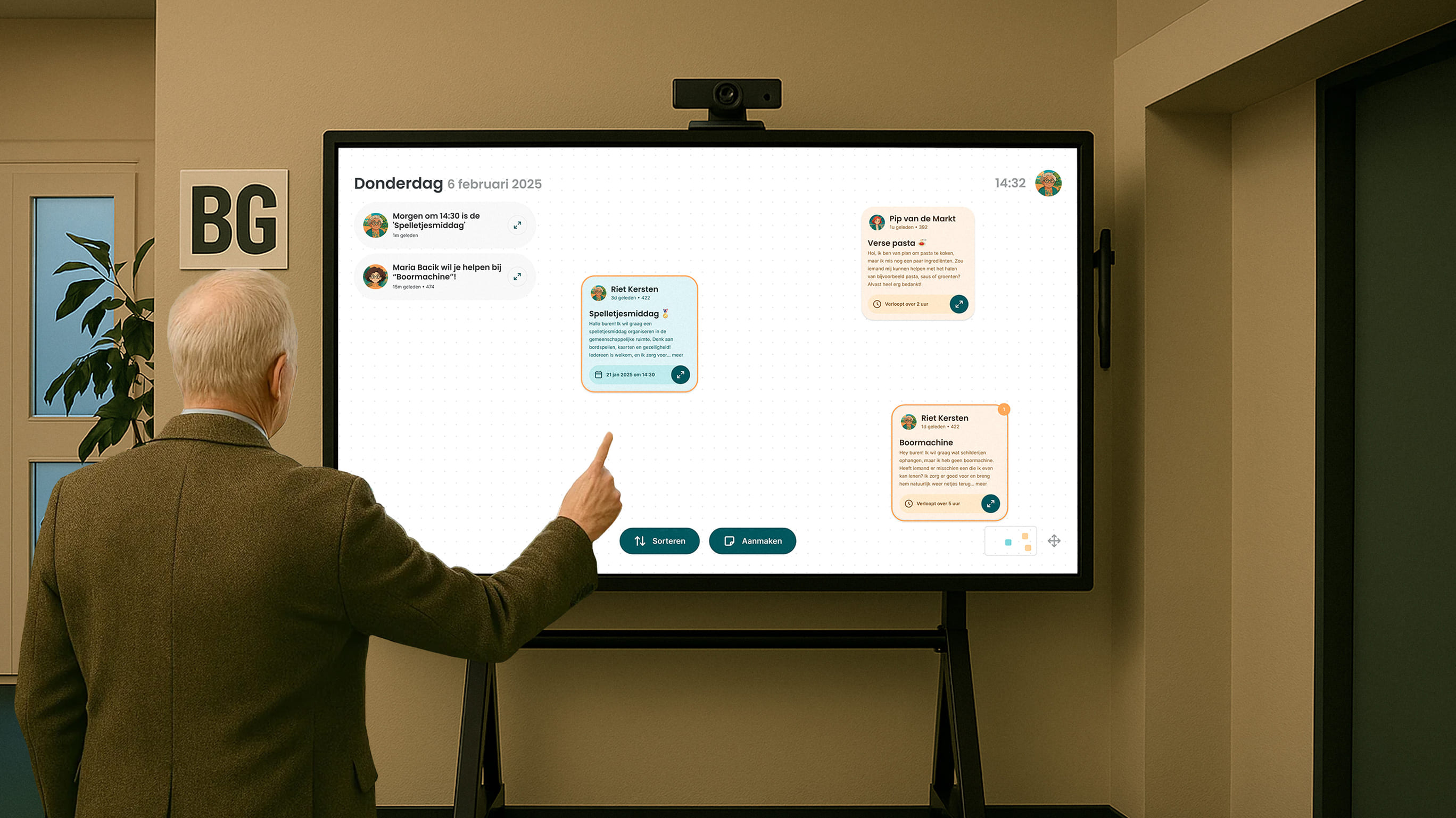
The Digital Bulletin Board helps residents initiate contact by posting needs, activities, and offers of support. It begins online but prompts face-to-face interaction, strengthening the community within the building.

A resident using the Hallo Buur digital bulletin board on a large screen A resident interacting with the digital bulletin board at De Aubade

Four flows. One community board.

Create an account.

Residents create a profile with their name, house number, and language preference. This simple step ensures posts and responses come from real neighbours, fostering trust while maintaining privacy.

Post an activity.

Residents can share events, questions, or small favours as digital post-its, which appear immediately on the shared board for others to view and respond to.

Responding to a request.

The sort button lets residents quickly find suitable posts by separating questions from activities. Replies trigger notifications for the original poster, facilitating real-life connections.

Manage profile settings.

Residents can control how they present themselves by adjusting their avatar, language, and accessibility options. This fosters safety, respect, and confidence.
Creating an account

Posting an activity

Responding to a request

Managing profile settings

What this project taught me.

Assumption barriers.

Co-creation helped uncover hidden beliefs between residents that no survey or interview could have revealed.

Contact, not connection.

Real interaction happens offline — the app just opens the door. The goal was never to replace face-to-face, but to make the first step easier.

Small barriers matter.

Even tiny obstacles can prevent people from connecting. Simplicity makes a difference.

Accessibility is key.

Simple flows and a Help Centre made the app usable for everyone. Balancing visibility and privacy builds trust.

Next project

Understanding Community Change